Showing posts with label Mission in Europe. Show all posts
Showing posts with label Mission in Europe. Show all posts
Tuesday, November 3, 2015
Friday, October 23, 2015
50th Anniversary of Fuller Theological Seminary's School of Intercultural Studies 21-24 October 2015
Program schedule: SIS 50th Anniversary Program Schedule
You can listen to the Sound Tracks:
Presentation Anne-Marie Kool:
<a href="https://soundcloud.com/fullerseminary/sis-50th-anniversary-missiology-lectures-anne-marie-kool"></a>
All soundtracks:
https://soundcloud.com/fullerseminary
You can listen to the Sound Tracks:
Presentation Anne-Marie Kool:
<a href="https://soundcloud.com/fullerseminary/sis-50th-anniversary-missiology-lectures-anne-marie-kool"></a>
All soundtracks:
https://soundcloud.com/fullerseminary

Friday, February 20, 2015
Kerk zijn in Midden en Oost Europa, 25 jaar na de val van het ijzeren gordijn - CEEAMS 2015
.jpg)
De jaarlijkse conferentie van de Central and
Eastern European Association for Mission Studies (Midden- en Oost-Europese
Vereniging van Missiologie) (CEEAMS) werd gehouden in Heiligenkreuz, in de
buurt van Wenen van 10-13 februari 2015. Het thema: “Voorbij het IJzeren
Gordijn: Kerk zijn in Midden- en Oost-Europa vijfentwintig jaar na de politieke
veranderingen”.
De deelnemers, voornamelijk afkomstig uit de regio, vertelden
verhalen van christenen die wonen en werken in die regio en analyseerden de
trends in kerk en zending na de gedenkwaardige gebeurtenissen van 1989.
CEEAMS is opgericht in 2002 en is een
internationale en interkerkelijke organisatie die zich inzet voor de
wetenschappelijke studie van vraagstukken van christelijke zending in Midden-
en Oost-Europa. Het doel is om de plaatselijke gemeenten te ondersteunen, te
versterken en toe te rusten om als open en gastvrije gemeenschappen te
functioneren en te getuigen van Jezus Christus in de wereld van vandaag.
De organisatoren van de conferentie waren er
vooral op gericht de gebeurtenissen van de 25 jaar grondig te analyseren. Het 'IJzeren
Gordijn‘ heeft Europa meer dan vier decennia verdeeld in West en Oost.
Christelijke gemeenschappen van beide kanten werden uitgedaagd om te gaan met
de realiteit van grenzen van prikkeldraad. Daarom ook had de val van het
communistische systeem gevolgen voor zowel Oost en West. De val van het IJzeren
Gordijn betekent niet dat het is verdwenen zoals de verroeste stukken het leven
van degenen die erop stappen blijft beïnvloeden.
Doel van deze conferentie was om
theologen-missiologen een kans te bieden om na te denken over de vragen hoe en
op welke wijze de communistische ervaringen het leven van de christelijke
gemeenschappen in Midden- en Oost-Europa (MOE) blijven beïnvloeden en wat het
betekent om kerk te zijn of te worden in de post-1989/1990 periode.
Vaak wordt alleen aandacht gegeven aan de
veranderingen in de voormalige communistische landen. In deze conferentie werd er van uit gegaan dat zowel het
westen als het oosten met de overblijfselen van het IJzeren Gordijn te maken
hebben. Daarom is het ook belangrijk om samen na te denken over de complexiteiten
die het leven, de positie en de gestalte van de christelijke gemeenschappen in Midden-
en Oost- Europa in de afgelopen vijfentwintig jaar gevormd hebben. Het doel van
de conferentie was om theologen-missiologen, Master- en PhD-studenten die zich
bezighouden met onderzoek in zendingswetenschap als ook geïnteresseerde kerkelijk
werkers en gemeenteleden uit verschillende confessionele achtergronden samen te
brengen.
Maar deze grondige analyse ging niet voorbij aan de
praktische consequenties. Elke spreker werd aangemoedigd de betekenis van deze
verhalen en analyse voor het huidige en toekomstige missionaire werk van de
kerk in Midden- en Oost-Europa te verhelderen. De toon werd gezet in de eerste
twee lezingen gegeven op dinsdagavond en woensdagochtend. Deze sessies maakten
duidelijk wat de fundamentele benadering van deze conferentie was, nl. een persoonlijke
en praxis georiënteerde benadering.
Er wordt gezegd dat alle theologie uiteindelijk
biografisch is. Om dit te onderstrepen werd de conferentie geopend door Prof.
Dr. Peter Penner die zijn pelgrimstocht in zending beschreef vanaf zijn
geboorte als een etnische Duitser in Kazachstan, op dat moment nog deel van de
Sovjet-Unie. Als tiener verhuisde hij met zijn familie naar Duitsland. Sinds
zijn studie theologie in Duitsland heeft hij aantal leidinggevende posities vervuld
aan theologische instellingen en werd zo bekend als een toonaangevende missioloog
in Midden- en Oost-Europa. Deze persoonlijke benadering werd gevolgd door
latere sprekers.
De tweede fundamentele benadering werd uiteengezet
door Prof. Dr. Anne-Marie Kool. Zij voerde aan dat in de theologie en
missiologie er vaak een sterke tweedeling is tussen theorie en praktijk. Aan de
ene kant kan de theologie en de theologische opleiding op het abstracte niveau gericht
blijven, en wordt er geen verband gelegd met de context. Op deze manier kan de
theologie dus niet relevant zijn voor het praktische kerkelijke en missionaire leven.
Aan de andere kant kan in het zendingswerk gemakkelijk voorbij gegaan worden
aan het belang om kritisch te reflecteren op het zendingswerk in het licht van
het evangelie. Missiologie moet beginnen met het verstaan van de context waarin
we leven, en vervolgens de vragen die de context opwerpt tegen het licht van het
evangelie houden en kritisch reflecteren op de context vanuit een
bijbels-theologisch perspectief. De andere sprekers volgden deze aanpak min of
meer op de voet.
In het licht van deze persoonlijke en praktijk
gerichte benadering, volgde na elke lezing een stevige discussie en debat over de
thema’s die aan de orde waren. De presentaties gingen over uiteenlopende en
gevarieerde onderwerpen, maar waren allen gericht op hoe het de christelijke
kerk in de afgelopen 25 jaar was vergaan en hoe het zich zou moeten richten op de
toekomst.
Er zijn enkele interessante feiten op te merken.
De samenstelling van de deelnemersgroep was zeer uiteenlopend. Een derde van de
sprekers in de ochtendwijdingen en in de lezingen waren vrouwen; een
indrukwekkend aantal voor een missiologische conferentie! Er was ook een flink
aantal jongere sprekers (onder de 30). Ze kwamen uit verschillende
denominaties: protestantse, evangelische, Baptist, orthodoxe en rooms-katholiek.
De meerderheid was afkomstig uit Midden- en Oost-Europa, met daarnaast een
aantal deelnemers uit West-Europa. De dertig deelnemers vertegenwoordigden 13
verschillende nationaliteiten.
Niet alleen waren de sprekers gevarieerd, maar ook
de contexten waarop werd gereflecteerd. Er waren lezingen over de gehele regio,
maar ook die gericht waren op verschillende landen: Rusland, Kirgizië,
Oekraïne, Bulgarije, Moldavië, Oost-Duitsland, Tsjechië, Slowakije, Roemenië en
Polen. Degenen die een lezing verzorgden hadden als kerkelijke achtergrond: orthodoxe,
rooms-katholieke, Baptisten, Lutherse, protestantse en Pinkster.
Afgezien van de grote verscheidenheid van
contexten, was er ook een grote verscheidenheid in de benaderingen van de
onderwerpen. De benaderingen omvatten statistische analyse, kritische
vergelijking en het gebruik van missiologisch modellen (Niebuhr's 'Christus en
cultuur ", de Pastorale Cirkel, kritische postmoderniteit en generationele
analyse).
Ten slotte was er ook een grote variatie in de
thema’s die bestudeerd werden. Onderwerpen varieerden van etnische minderheden /
religieuze ervaring en getuigen zijn, missiologisch zaken zoals missionair gemeente
zijn, pluralisme, sociaal engagement, missiologisch onderwijs en verhouding kerk
/ staat na 1989.
In deze conferentie kwam een veelheid aan thema’s
aan de orde, met een veelheid aan benaderingen, in de veelheid van contexten,
door een groot aantal sprekers, met een persoonlijke en praktijk gerichte
benadering. De reflectie was grondig, persoonlijk en praktisch. De deelnemers vertrokken
verrijkt door de ervaring van de lezingen en van het open gesprek. Ze hebben
ook de mogelijkheid om toegang te krijgen tot bibliografische materiaal, dat de
Kerken, zendingswerkers, en zendingsorganisaties zal helpen om zending in Midden-
en Oost-Europa te benaderen op een meer theologisch coherente manier en om meer
praktisch te worden toegerust om deze taak te vervullen.
Het is duidelijk dat onderzoek en discussie de
komende jaren moet worden voortgezet: er is nog heel veel onbewerkt terrein.
Neem voor meer informatie contact op met: Dr.
Dorottya Nagy (dorotti@hotmail.com)
Voor meer informatie over CEEAMS: www.ceeams.org
Friday, November 21, 2014
EEMA Conference 2014: Revolutions in European Mission
EEMA Conference 2014
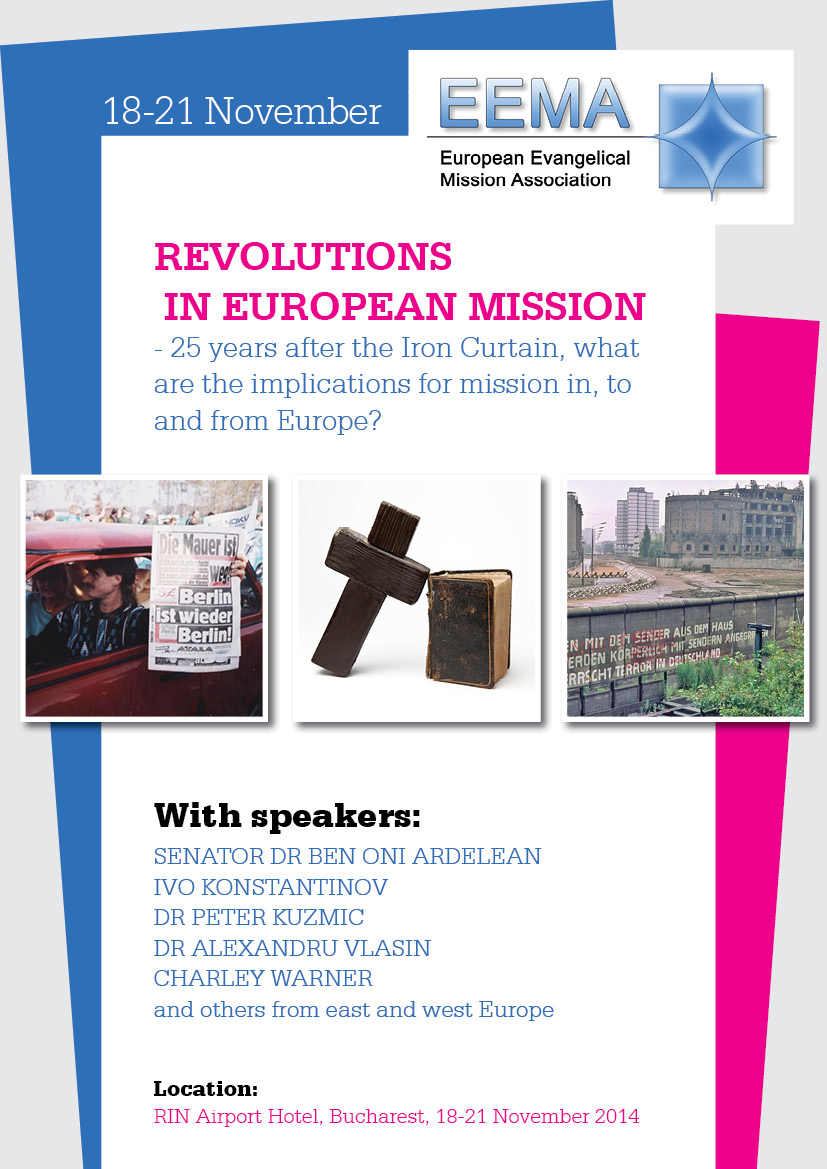 REVOLUTIONS IN EUROPEAN MISSION
This year’s EEMA conference took place in Bucharest from 18th to 21st November. As is appropriate on the anniversary of the fall of the Iron Curtain it reflected on 25 years of mission in eastern Europe and where mission to, in and from Europe goes in the next 25 years.
85 people from 23 different countries attended, including a variety of speakers representing mission agencies, Bible colleges and denominations were present, representing a variety of viewpoints both from within and outside Europe.
A dominant theme to emerge from the conference was how much the first couple of decades after the fall of the wall were often characterised by misunderstanding and mistrust between east and west, though we were encouraged to see that in recent years there has been more of an effort at mutual understanding and co-operation. It could even be said that now, where the shadow of the wall was once very long, a new bridge is being built, bringing together different communities to talk, relate together and collaborate to bring the gospel to unreached communities in Europe and beyond.
Following an introduction our hosts Wolfgang Büsing (Director, AEM Germany) and Martin Lee (Director, Global Connections UK) we were welcomed to Romania with greetings from Rev Virgil Achihai (President, Romanian Evangelical Alliance), Dr Otniel Bunaciu (President, European Baptist Association), and Dr Ioan Ceuta (President, Romanian Assemblies of God). Our theme of unity was underlined by the evident co-operation between these leaders of the three largest protestant denominations in Romania.
Plenary topics included:
- What has been achieved in 25 years of eastern European mission? (Dr Anne-Marie Kool)
- Geopolitical and economic implications for mission in eastern Europe (Dr Ivo Konstantinov)
- What I wish my foreign mission partners know about mission in my country (Charley Warner)
- 25 years of past and future mission cooperation between east and west Europe (Dr Alexandru Vlasin)
- Younger missional leaders: coming out of the shadow of the past (Anton Ponomarev)
Other speakers included Rev. Tim Herbert (UK), Volodymyr Kondor (UA), Niklaus Meier (CH), Viktor Ormanji (MD), Camelia Vlasin (RO) and Russell Woodbridge (US), and a particular highlight was a guided tour of the People’s Palace in Bucharest together with a speech from Dr Ben Oni Ardelean, a Senator in the Romanian parliament.
Discussion centred around celebrating some of the achievements of mission workers from a variety of eastern European countries, several of whom have significant ministries in other countries, particularly in central Asia, and on working together to pool resources and move forward together in mission in, to and from central and eastern Europe.
We regret that pdfs, powerpoints and audio files are only available to people at the conference. If you weren’t present, sorry you missed out! Make sure you come to our next conference.
Saturday, November 1, 2014

Tuesday, October 16, 2012
Global SHIFT consultation - Welcome
Dear GlobalSHIFT Participants:
Warm greetings!!
We are at the threshold of the GlobalSHIFT consultation. For many months we have been praying, thinking, talking, working and planning this event. Finally, the last leg is upon us: we are arriving in Budapest, moving toward the dream, and eager to see what God will do this week.
TJ Addington (Senior Vice President of the EFCA and Executive Director of ReachGlobal) described this consultation as a “game-changing” event, and I believe this is true. I think that GlobalSHIFT is already changing the way we see ministry in Europe. It is changing our expectations and raising our eyes to expect even bigger things from the Lord, and it is raising our excitement as we become part of what the Lord is currently doing in Europe.
GlobalSHIFT is a consultation. It is something different than what we usually experience in our meetings. During a consultation the plenary speakers are the facilitators of the conversation. They are responsible to ignite the dialogue, but the most important part of the consultation will happen in the table groups, during the networking time, and in the conversations with other participants. We will be receiving very valuable insights from the platform (during the plenary and panel discussion), but we, at the ground level, will have the responsibility to process the information and look for applications to our life, team and ministry.
During this consultation we will be experiencing the changing world as much as we will be reflecting about the changes. The world is changing, and we have been observing the changes in two different areas. The first area is “the changing map of the church and mission.” This means that the growing church and missionary forces from Africa, Asia, and Latin America are taking more responsibility and participation in re-shaping the image of the church and the way we do missions. During this consultation we will hear what the Lord is doing in those churches directly from leaders who are playing key roles in this process in their parts of the world. We will have invitees from Latin America, Southeast Asia, and the Middle East that will help us understand more about this major shift in the Church.
The second area is the “changing topography of the church and mission.” This means that in these changing times, the Lord is raising new voices from “non-traditional” places where the church is growing and new mission forces are emerging. René Padilla is one of the voices that the Lord has been using, not only in Latin America, but also from Latin America to the rest of the world. His reflections, writings, and talks are affecting and influencing the way the Global Church understands the new realities. An example is the deep impact of his talk in the context of the Lausanne Covenant during Lausanne 1974, and how he continued from there as a reference for the fresh reflection of Latin American church.
K. Rajendran, from India, is another strong voice. The Lord had been using him to lead the reflection process about what it means for the Church in India to become engaged in mission, especially during the process when the Church in India is becoming independent from overseas organizations (a very unique opportunity and experience). He has been playing a key role in growing the number of mission agencies in India from 73 to almost 350 today. He has been a missionary and actively involved in missions mobilization.
To use an airplane metaphor that TJ Addington likes, we can say that every day we will start flying at 30,000 feet. From that altitude, René will be giving us an overview about how he sees the shift in the world. He will be raising specific issues. Some might be totally unexpected and different, but they are important because the issues represent his experience in flying at that altitude in different territories. For some of us without this experience, these thoughts might not sound eminently important, yet according to the signs of the times, they will be in the near future.
In the mornings, René will be sharing biblical and missiological insights on three issues we defined for our consultation: Globalization, Kingdom Connections, and Integral Mission (or How We Do Missions). You will notice that he will be leading us from the Global to Local as the week progresses. In globalization he will be presenting a broad view about major shifts in the world. The perspective will be a long horizon, like an airplane flying over the ocean. The focus will be the whole world and how globalization is affecting those who are living today.
In the second day, René will be speaking about kingdom connections, more specifically about the major challenges for the Church. He will be presenting a more defined landscape by raising the ecclesiological, missiological and spiritual challenges for the church and individuals and extending the call for us to see ourselves as one church with a call to unity, solidarity and partnership.
On the third day, René will speak about integral mission. At this point, we will begin to see the runway. Our perspective is still from a high altitude, but we will see the lights and outline of where are we going to land. In this third day, René will be speaking more to us as pastors and missionaries, to reflect our understanding about mission and the way to do mission today in a world that is changing and in a church that is in a process of transformation.
After René Padilla’s time, we will have the opportunity to hear other voices. During the daily panel discussions, we intend to fly at a lower altitude and in more specific territory. The voices will be from Western Europe, the United States, the Middle East, Eastern Europe and Latin America. Our panel will be sharing other views of the landscape. They will help us move from the big picture to a clearer image of the changes, challenges and situations that confirm the shifts presented by René.
The most exciting part of the process is when we move to our table groups. During that time, we will be moving to the cockpit, and as a group, we will work hard to choose the runway and to land the airplane. We will be looking for practical ways to apply all that we have heard and experienced to our own realities. We expect that the implications might change our way of thinking about the church and doing mission.
Each day will end with a plenary talk by K Rajendran. He will help us see additional options and recommendations from his lengthy experience navigating the terrain at high and low altitudes. K will present some practical examples of applications from different parts of the world.
René Padilla and K Rajendran both represent new voices emerging from new territories of the church. As such, they will provide the opportunity to experience the way in which they are reading the Bible in the Global South. They will provide us the opportunity to experience different contexts, identities, and reflections about the Gospel. I hope that you will be enlightened, and will enjoy these fresh perspectives.
We are beginning a very exciting journey. The good news is that God is in the control tower. He has the plan and He is watching every one of our airplanes. God is doing everything needed for a safe trip and effective landing. His Holy Spirit is empowering us to be fearless, and He is sharing his Spirit of power, love and self-discipline to firmly hold the controls in our hands, and to believe that, at the end of the day, we are just following His plan and honoring His commands.
As we arrive for this experience, my prayer is that you can “sit back, relax and enjoy” this exciting journey that the Spirit has prepared for us.
Welcome to the GlobalSHIFT Consultation.
David Ruiz
For Consultation Media resources: http://globalshiftconsultation.org/consultationmaterials/
Subscribe to:
Posts (Atom)